
Whole-home filtration · Bosque Farms
Take the chlorine and well odors out of every Bosque Farms faucet
The village disinfects its deep-well water with chlorine, which is exactly what a public system should do. Catalytic carbon at your main line reduces that taste and smell once the water is in your house — and on a private well, the right media can deal with sediment, iron or sulfur.
What filtration helps with in Bosque Farms
And, just as important, what it doesn't.

Chlorine
Reduces the pool-water taste and odor that village disinfection can leave behind, in showers as well as drinking glasses.

Sediment
Catches fine grit that can come up with well water and wear on valves, aerators and appliances.

Many VOCs
Catalytic carbon reduces a range of volatile organic compounds along with off tastes.

Well-specific media
Iron, manganese or sulfur on a private well can be addressed with specialty media once a test confirms them.
Carbon is not an arsenic treatment
Whole-home carbon does not remove arsenic, nitrate or hardness. Arsenic in local groundwater is something the village is working to address, and its annual water quality report has the official data. For drinking water at home, under-sink reverse osmosis is the usual approach.
Your free test decides the media
We read hardness, TDS, pH, chlorine, iron and manganese, and sulfur at your sink, then explain each number. On village water, chlorine is the reading that matters most for filtration, and hardness tells us whether pairing the filter with a softener makes sense. On a private well, iron, manganese and sulfur steer the media choice, and we'll help you get lab testing for bacteria, nitrate and arsenic because a field kit can't confirm those.
Most Bosque Farms homes with filtered-water goals also have hard water, which is why our Soft + Filtered Home package combines both in one tank for $3,450.
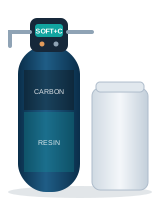
Installing filtration on a Bosque Farms property
- 1
Locate the entry point
Village customers usually have the main coming into a garage, laundry room or utility closet. Well properties may have a well house or a pressure tank in the garage.
- 2
Set the order
On a well, treatment goes after the pressure tank. Lines to arenas, barns and hay-field hydrants can usually branch off first and stay unfiltered.
- 3
Finish the job
Our own installers plumb in a bypass, connect the drain, check for leaks and confirm the chlorine reading drops, all in roughly half a day.
More about the technology on our whole-home filtration page, or read the Bosque Farms water overview. Book a free water test to get started.
Filtration FAQs for Bosque Farms
Does Bosque Farms use chlorine in its water?
Yes. The village disinfects its well water with chlorine, which keeps it safe in the distribution pipes. Carbon filtration simply reduces the taste and smell once it reaches your home.
Will a whole-home filter lower arsenic?
No. Catalytic carbon isn't designed for arsenic. Point-of-use reverse osmosis is the standard home approach, and performance should be confirmed with testing.
My well smells like rotten eggs. What helps?
That odor usually points to sulfur. Depending on the test, catalytic carbon or a specialty media may reduce it. We confirm with a sulfur reading first.
Do I need a softener too?
If your hardness reading is high, pairing the two makes sense, and our combined tank keeps the footprint small. If hardness isn't an issue, we'll say so.
Find out exactly what's in your water — free.
A 15-minute on-site test with results in real time, a plain-English report, and an honest recommendation. No pressure, no obligation.