
Albuquerque, NM
Albuquerque water, neighborhood by neighborhood
The same city tap can behave differently in a 1940s Nob Hill bungalow, a new Ventana Ranch build and a South Valley home on its own well. Here's how to sort out what your house actually needs.
Where Albuquerque's tap water comes from
Most homes in the city are served by the Albuquerque Bernalillo County Water Utility Authority, usually shortened to ABCWUA or simply "the Water Authority." Its supply isn't a single source. Part of it is San Juan–Chama water carried into the Rio Grande and cleaned up at the utility's surface water treatment plant; the rest is groundwater pumped from the aquifer beneath the basin.
That blend matters at your faucet. In drought years the utility leans harder on groundwater, so the character of the water arriving at your house can drift from season to season and year to year. Owners often notice it first as heavier spotting on shower glass or a crust that seems to come back faster on the kettle.
For disinfection, the Water Authority uses chlorine, generated on-site as sodium hypochlorite. It's what keeps the distribution system safe, and it's also the reason some households notice a pool-like smell from a freshly drawn glass.
Want the official numbers?
ABCWUA tests its water and publishes the results every year in its Consumer Confidence Report. That report is the right place for regulated contaminant data. Our free test answers a different question: what is your water doing to your plumbing, skin and appliances right now?
- Utility
- ABCWUA, for most addresses inside the city
- Sources
- Treated San Juan–Chama surface water blended with aquifer groundwater
- Disinfectant
- Chlorine (not chloramine)
- Exceptions
- Some South Valley properties still run on private wells
Four parts of town, four different starting points
Water from the same utility, but very different houses receiving it.

Nob Hill & the University area
Older homes near Central and UNM often have tight utility closets and decades of scale already inside the lines. Planning the install around limited space is half the job here.

Westside & Northwest Mesa
Taylor Ranch, Paradise Hills and Ventana Ranch are mostly newer subdivisions with garage water heaters and plenty of tankless units, which are worth protecting from scale early.

Foothills, NE Heights & Four Hills
Larger households, more bathrooms and lots of glass shower enclosures. Spotting and fixture buildup tend to be the complaints we hear most on the east side of town.

North & South Valley
Mostly on city water, but the South Valley still has homes on private wells while ABCWUA extends lines into well-dependent areas. A well calls for lab testing, not guesswork.
Pick the problem, then the system
Each of these pages goes deeper into how that equipment fits Albuquerque homes.
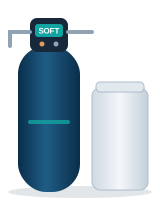
Scale, spots and dry skin
Albuquerque water commonly tests hard, and the desert air makes hard-water skin feel worse. See how water softeners for Albuquerque homes are sized and installed in each part of town.
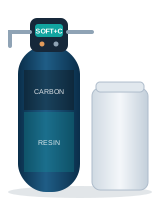
Chlorine taste and smell
If the shower smells like a swimming pool, catalytic carbon is the answer. Read about whole-home filtration in Albuquerque and why it pairs well with a softener.
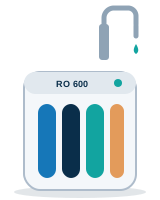
Better drinking water
For lower dissolved solids at the kitchen tap, or a South Valley well that needs a closer look, start with reverse osmosis in Albuquerque.
What a visit looks like
A local water specialist comes out, runs a roughly 15-minute test at your sink and walks you through hardness, TDS, pH, chlorine, iron and manganese, and sulfur as the readings come in. You keep a printed, plain-English report. If the honest answer is that you don't need anything, that's what you'll hear. When something does make sense, the three installed packages carry a lifetime warranty, free installation and financing from $59/mo. The free test is explained in more detail on the water test page.
Albuquerque questions
Does Albuquerque use chlorine or chloramine?
ABCWUA disinfects with chlorine, which it produces on-site as sodium hypochlorite. That's good news for filtration, because catalytic carbon handles chlorine taste and odor very effectively.
Why does my water seem different some years?
The Water Authority blends treated surface water with groundwater, and the mix shifts toward groundwater in drought years. As the blend changes, so can the mineral character you notice on fixtures and glass.
Do you work in every part of the city?
Yes. We test and install across Albuquerque, from Downtown and Old Town to Uptown, the Academy area, the Westside, the Foothills and both valleys.
My South Valley home is on a well. Can you still help?
Yes. Private wells aren't regulated like the city system, so we start with our on-site test and help you arrange lab testing for bacteria, nitrate, arsenic and other concerns before recommending any equipment.
Find out exactly what's in your water — free.
A 15-minute on-site test with results in real time, a plain-English report, and an honest recommendation. No pressure, no obligation.